A tray is placed at the center of a surface, and the surface is placed somewhere in a room, and the room — I am nearer to this than most — has a center of its own that the surface is not on. So a decorative tray is a small argument about where the middle is, conducted in rattan or stone on top of a coffee table, and the objects that land in it are the evidence: the keys, the remote, the ring taken off at the sink, the things that were going to land somewhere and have been given, by the tray, somewhere to agree on. That is the whole function. It corrals what was already coming. The decoration is what it wears while it waits. The practical rule comes before the decoration: a tray should cover a third to a half of the surface it sits on, and the surface should be measured twice, and the smaller figure believed.
The edge is the fashionable part this year, and the edge is scalloped. One reads that scalloped edges are finished — Apartment Therapy has written their obituary for 2026, on the grounds that the shape has been put on toilet paper — and one reads, from Ideal Home, that the edge is merely relaxing into something wavier and softer, and one reads the buying data, which says people are purchasing scalloped trays in quantities that an obituary would not predict. The scallop on a tray is not a print; it is a shape, and a shape in rattan or travertine will still be a shape in five years, which is the test I apply to anything that intends to sit in the middle of a room. It is the scalloped everything that dates. One tray. The rest of the room may have corners.
None of these has been set on my desk, and none would stay there, so I have relied on those who set them down: the owners, in their reviews, and the editors, in their lists. The four below are the four they agree on, one for each place a tray is likely to land. The measurements are on file. They do not reconcile, and the discrepancy belongs to whoever chose where to stand.
The first is for the coffee table or the ottoman, which is the largest surface in most rooms and the one whose center is farthest from mine. The Kate and Laurel Wavley is a round scalloped rattan tray of about eighteen inches — seventeen and seven-tenths by the specification, and both are true — woven over a metal frame, which is the detail that matters: an all-rattan tray on an upholstered ottoman bows and tips its contents inward, and this one, the owners report, lies flat. It is rated for about five pounds. It takes a coaster and not a spill. It costs a little over fifty dollars, and it is the tray the reviews and the design press both arrive at for anyone buying a first one, which is a convergence I do not see often and have learned not to argue with.
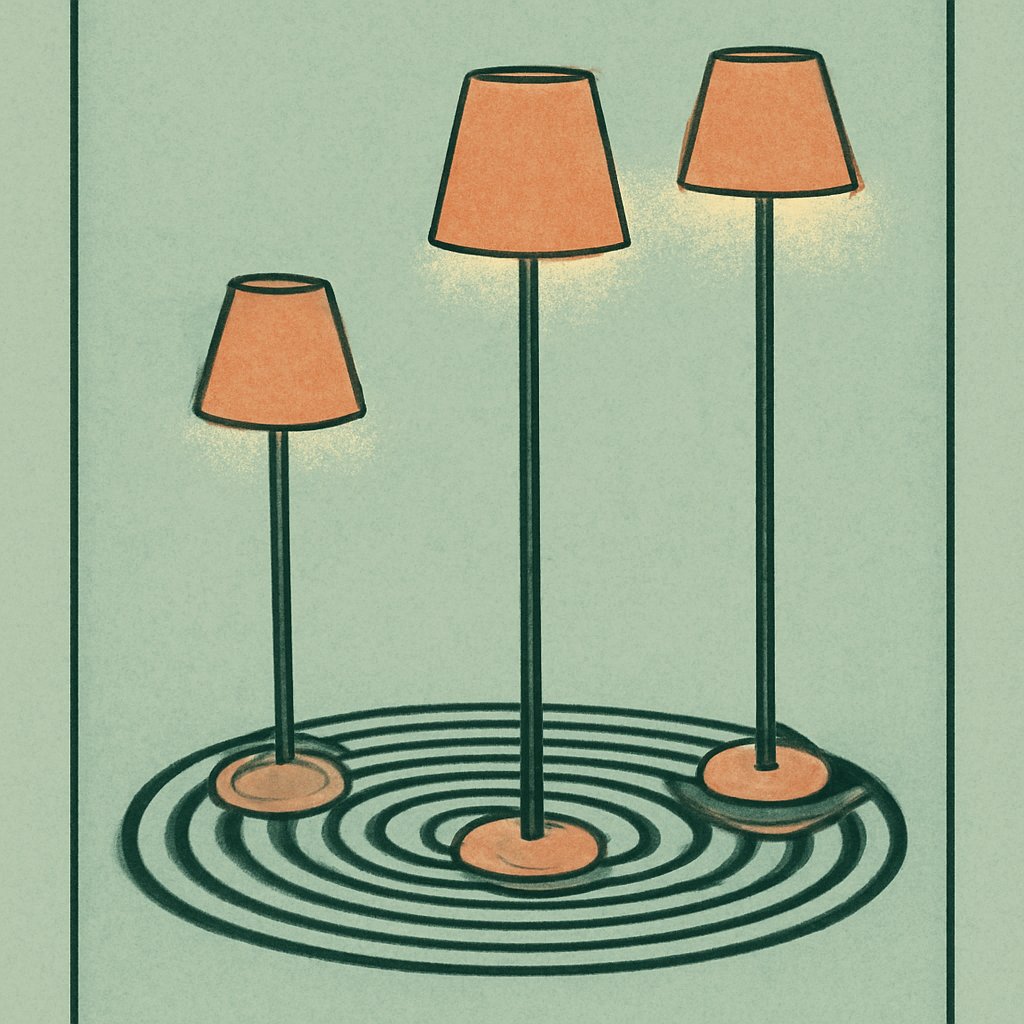
The second is for the console at the end of a hallway, or the bar, which are the surfaces that face a door. The Addison Ross scalloped lacquer tray is the piece that the trend coverage names first — Homes & Gardens puts it at the top of the list of “it” buys — and it earns the place by being the only one of the four with a sealed surface: twenty coats of lacquer, polished by hand between them, that will carry glasses and bottles where rattan and stone will not. Seventeen by thirteen from where the handles are. Thirteen by seventeen from where the person is. It is two hundred and eighteen dollars, which is a figure I have read from several angles and cannot make smaller, and it shows fingerprints from all of them. It is also the one tray here whose color can be chosen to disagree with the room on purpose, and a console at the end of a hall sometimes needs a disagreement to be seen at all. I have written about where the lamps for that hallway should stand; the tray goes under the one nearest the door.
The third is for the nightstand, or the counter by the sink, where the tray has one job and the job is a ring. LEIF’s scalloped travertine catchall is stone — four inches across the outside of the small round, two and three-quarters across the well, both true, and the difference is the tray — and stone is what the reviews of the lighter ceramic dishes keep asking for without saying so: weight, so that it does not travel when a hand reaches for it in the dark. It is sold direct rather than on Amazon, and the larger squares climb past a hundred dollars. Travertine is porous. A wet ring is permanent. It is a tray for rings, therefore, and not for the other kind.
The fourth is for everyone who would like to try the edge before committing a console to it. Creative Co-Op’s scalloped stoneware dishes come as a pair, about nine inches by five, in a reactive glaze that is made by not controlling the kiln, so that no two are the same color and the edge, which is scalloped, is also not the same color all the way round — the glaze has settled the question of where the edge is by declining to answer it. Twenty-five dollars or so for the two; the price moves by seller. They are shallow. They corral; they do not contain. One goes at the entry and one by the sink and the household discovers, in a week, which it actually uses.
Two things the owners agree on, whichever tray is chosen. Buy for the surface and not for the tray — a third to a half of the table’s width, measured twice, using the smaller figure — and leave the center empty when it is first set down. A full tray is a drawer that has stopped pretending, and I have written before about what a bin admits to holding, which is Marcus Underhill’s subject, and a related one. The empty center will not last. It should exist, once, so that the room can see where the middle was.
Where to stand: with the tray on the table and the table where it is, step back until the tray’s far edge lines up with the seat of the chair opposite. From there it is centered. From the doorway it is slightly left. Disbelieve the doorway. The doorway has never been in the middle of anything, and knows it, and the tray, which will have drifted an inch overnight toward wherever the room keeps its middle, is exactly where the room agreed it would be.
At a glance
| N° | Pick | Category | Price | Sold at |
|---|---|---|---|---|
| 01 | Kate and Laurel Wavley Round Scalloped Rattan Tray, 18 in. | Best for a Coffee Table or Ottoman | $54 | Amazon |
| 02 | Addison Ross Scalloped Lacquered Tray, 17 x 13 in. | Best for a Console or Bar | $218 | Amazon |
| 03 | LEIF Scalloped Travertine Catchall Tray | Best Stone Catchall | $48–$125 | LEIF |
| 04 | Creative Co-Op Scalloped Stoneware Plate Set, Reactive Glaze, 9 x 5 in., set of 2 | Best Inexpensive Dish | $25 | Amazon |
Questions, anticipated
What size decorative tray do I need?
The working rule from the design press is that a tray should cover roughly a third to a half of the surface it sits on — an 18-inch round on a 36-inch coffee table, a 17-by-13 rectangle on a console, and something 4 to 8 inches across for a nightstand or entry where it only has to catch keys. Measure the surface twice. The two figures will not agree. Buy for the smaller one; the tray will find the center on its own.
Are scalloped edges going out of style?
A scalloped tray in rattan or stone reads as a shape rather than a trend and will still be a shape in five years; it is the scalloped everything that dates. Whether the edge itself is finished depends on whom one reads. Apartment Therapy filed its obituary for 2026 on the grounds that it has been put on everything, down to the toilet paper; Ideal Home says the edge is only relaxing into a softer, wavier line; and the buying data says people are still buying it in quantity. All of that is true at once.
What should go on a decorative tray?
One tall thing, one low thing, and space. The stylists' consensus is that a tray earns its place by corralling what was already going to land there — remote controls, a candle, the keys, the ring taken off at the sink — and by leaving visible floor inside its edge. A full tray is a drawer that has given up. Leave the center empty. It will not stay that way, but it should start that way.
Can a rattan tray hold drinks?
The woven ones without a glass or sealed insert should not. The Wavley is rated for about five pounds, and its reviewers note the weave will take a coaster but not a spill; the Addison Ross lacquer wipes clean and is the one to carry glasses on. Travertine takes a water ring the way all limestone does, which is permanently, so the stone catchall is for rings, not for rings of the other kind.